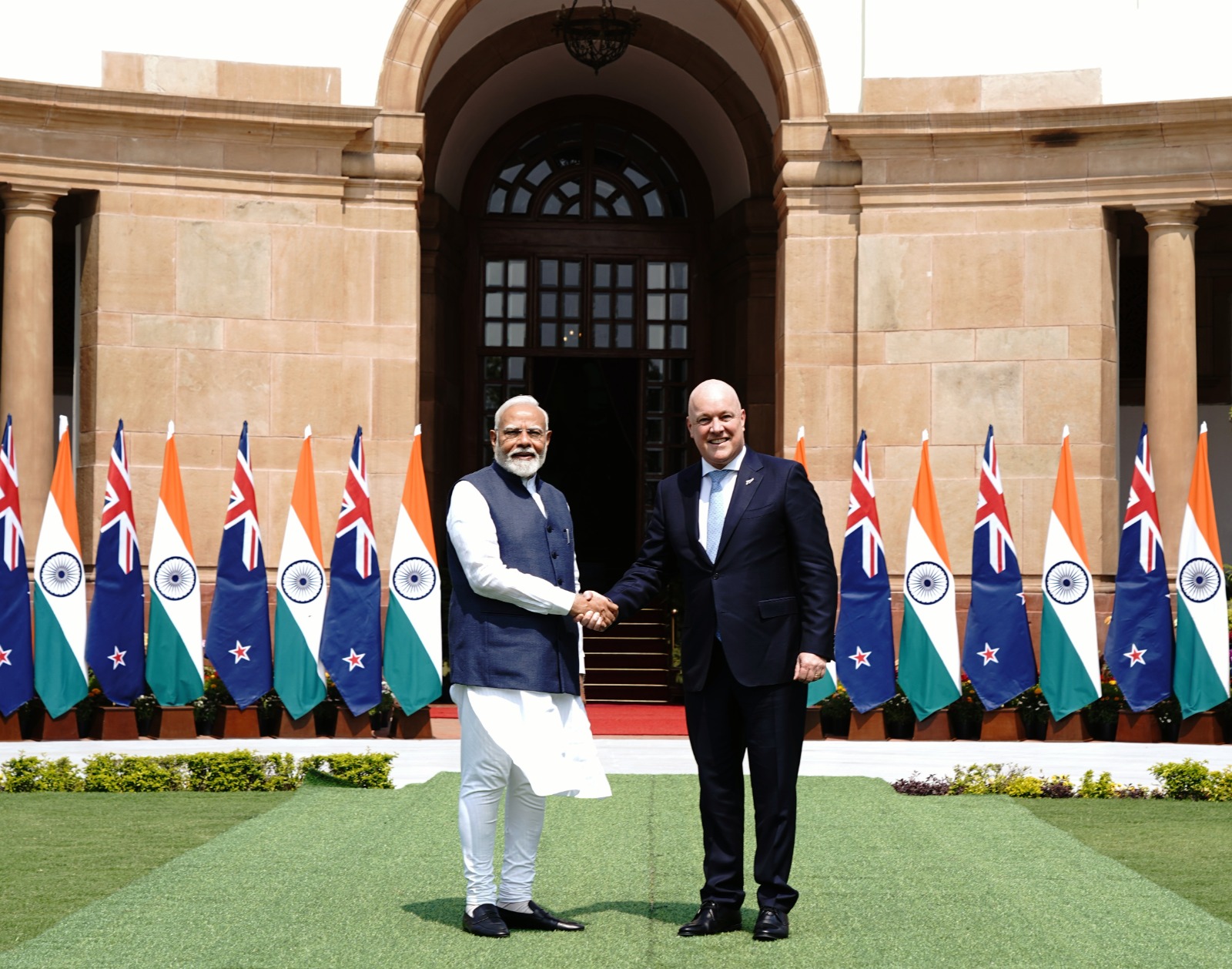
India and New Zealand on 22 December 2025 announced the conclusion of negotiations on a comprehensive Free Trade Agreement (FTA), marking a significant milestone in bilateral relations and deepening economic engagement between the two Indo-Pacific partners. The agreement, concluded after an accelerated nine-month negotiation process, is being described by both governments as a “new-generation, people-centric trade pact” aligned with India’s vision of Viksit Bharat 2047 and New Zealand’s long-term export diversification strategy.
The FTA comes at a time when India is emerging as the fastest-growing G20 economy, projected to become the world’s third-largest economy by 2030, while New Zealand is seeking to reduce dependence on traditional export markets and strengthen its footprint in Asia.
Strategic Importance of India for New Zealand
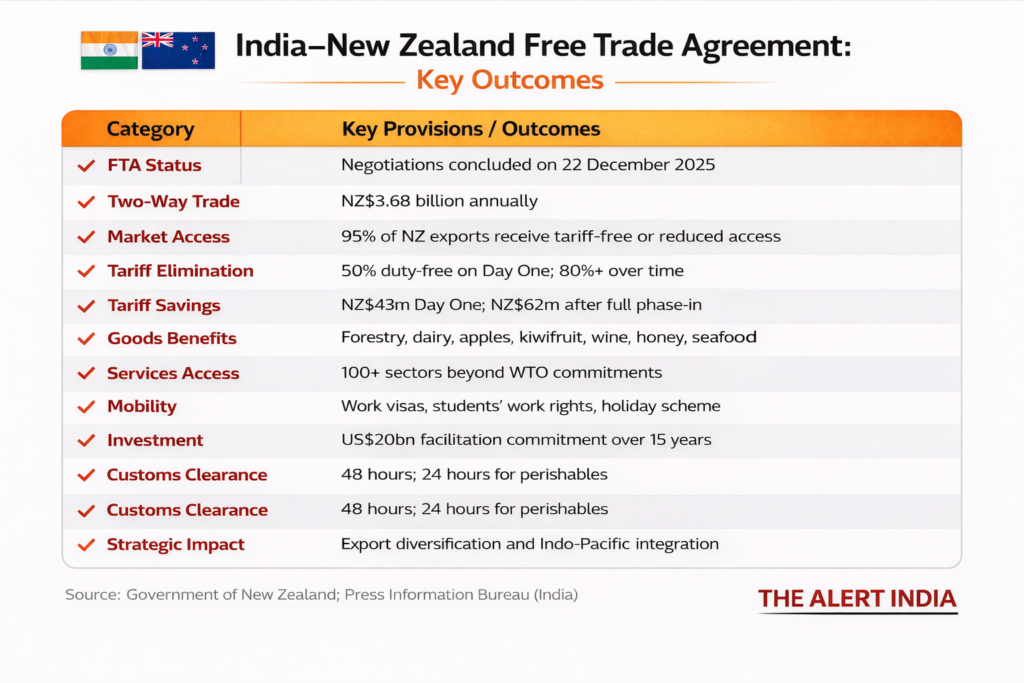
For New Zealand, India represents both an economic opportunity and a strategic priority. Despite being one of the world’s largest and fastest-growing economies, India currently ranks only as New Zealand’s 12th largest export market, accounting for 1.5% of total exports. Total two-way trade stands at NZ$3.68 billion annually, with New Zealand exports to India valued at NZ$1.79 billion in the year ended June 2025.
Wellington sees the FTA as a gateway to India’s rapidly expanding middle class, expected to exceed 700 million consumers within five years, larger than the entire population of the EU or ASEAN. New Zealand officials have also emphasised the role of India’s 300,000 strong diaspora in New Zealand as a “living bridge” supporting deeper trade, education, cultural, and social ties.
Tariff Liberalisation and Market Access Gains
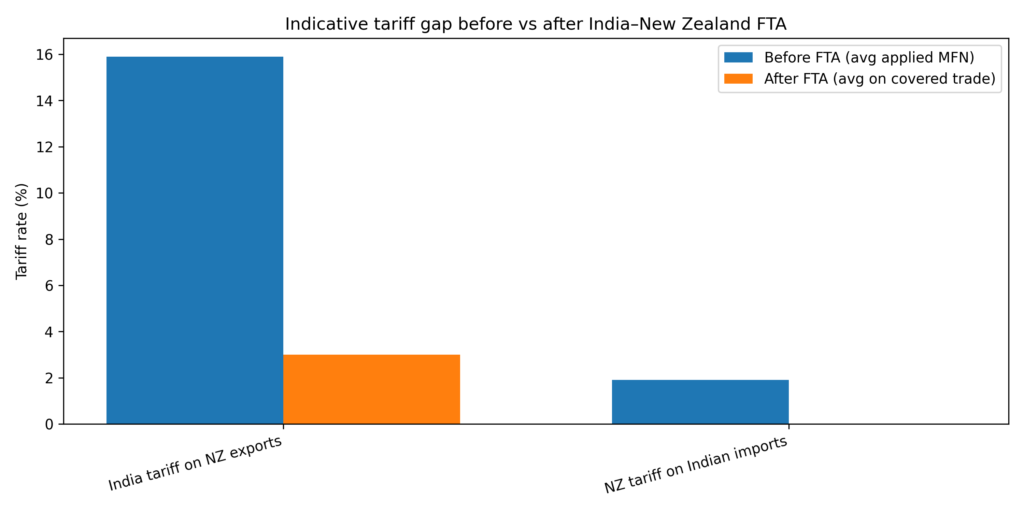
A central pillar of the agreement is tariff liberalisation, with 95% of New Zealand’s current exports set to become tariff-free or subject to sharply reduced duties over time. More than 50% of exports will enjoy full tariff elimination from day one, rising to over 80% once the agreement is fully phased in, bringing the average applied tariff down to just 3%.
Estimated tariff savings are projected at NZ$43 million on day one, increasing to NZ$62 million based on current trade levels, with further upside as trade volumes expand.
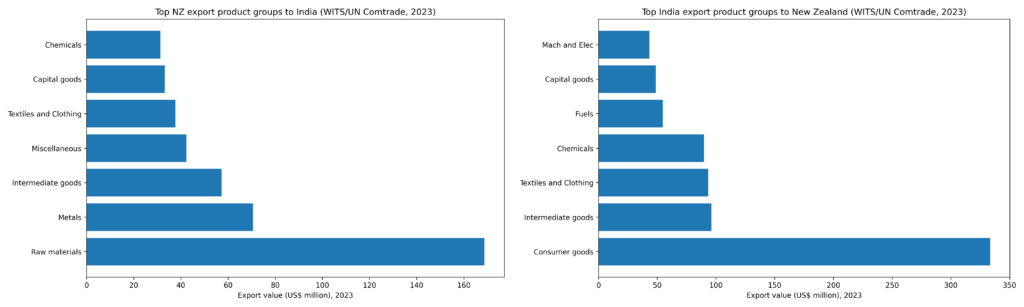
For India, the FTA delivers zero-duty market access on 100% of its tariff lines, boosting competitiveness for labour-intensive sectors such as textiles, apparel, leather, engineering goods, pharmaceuticals, marine products, gems and jewellery, and handicrafts.
Services, Talent Mobility and Education
Services trade emerges as one of the most significant outcomes of the FTA. India has committed to almost 100 additional service sectors beyond its WTO obligations, including IT and IT-enabled services, professional services, education, financial services, tourism, construction, audio-visual services, and telecommunications.
Crucially, a Most Favoured Nation (MFN) clause ensures that any future improvements offered by India to other FTA partners will automatically extend to New Zealand. The agreement also establishes a future-ready mobility framework, including:
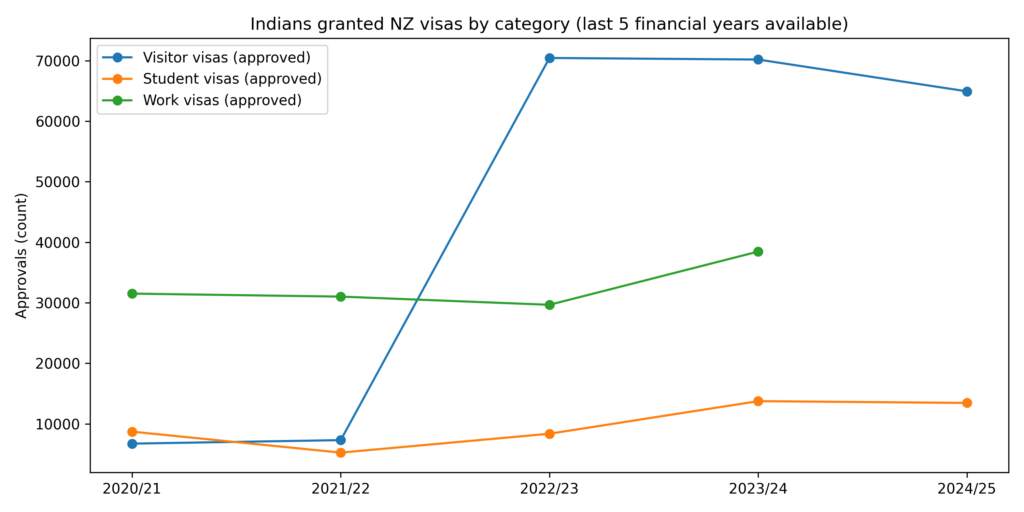
- 5,000 Temporary Employment Entry visas for skilled Indian professionals,
- 1,000 Working Holiday visas annually
- Expanded post-study work rights for Indian students in New Zealand,
strengthening talent flows and people-to-people engagement.
Investment and Economic Cooperation
Investment cooperation forms another core pillar of the FTA. New Zealand has committed to facilitate up to USD 20 billion in private sector investment into India over 15 years, supporting India’s Make in India and infrastructure ambitions. India will establish a dedicated New Zealand Investment Desk to assist investors throughout the investment lifecycle.
The agreement also creates structured cooperation mechanisms across agriculture productivity, fisheries, horticulture, apiculture, tourism, audio-visual production, sports, traditional knowledge systems, and renewable sectors, supported by working groups and centres of excellence.
Trade Facilitation, Customs and Regulatory Cooperation
The FTA includes advanced provisions on customs procedures and trade facilitation, ensuring goods clearance within 48 hours, and within 24 hours for perishables and express consignments, provided regulatory requirements are met.
Modern rules of origin, paperless trade systems, self-certification for approved exporters, and enhanced cooperation on sanitary and phytosanitary (SPS) and technical barriers to trade (TBT) are expected to reduce transaction costs and provide greater certainty for exporters on both sides.
A New-Generation Trade Partnership
Officials in New Delhi and Wellington have described the agreement as a “balanced, forward-looking and future-ready” trade pact that integrates trade liberalisation with employment, skill mobility, MSME participation, sustainability, and cultural cooperation. The FTA is among the fastest concluded agreements between India and a developed economy, following five formal negotiation rounds and extensive inter-sessional engagement during 2025.
With negotiations now concluded, the agreement will undergo legal scrubbing, followed by signature and domestic ratification processes in both countries before entering into force.
Source: New Zealand Government – Ministry of Foreign Affairs & Trade; Press Information Bureau, Ministry of Commerce & Industry, Government of India